Fabric & craft
What each cloth is, how it behaves, and how to keep it — so you know what you are buying before it arrives.
Why it matters
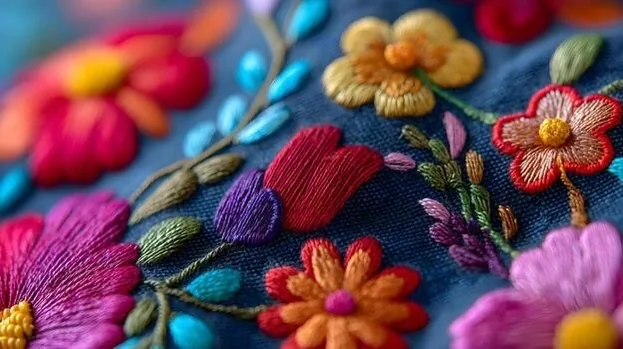
Close up is where the difference is
From a distance one cotton kurta looks much like another. The difference is in the stitch, the weight of the cloth and how the edges are finished — so the pictures below are close-ups of the cloth itself rather than flat swatch cards.
Six fabrics, what each is best for, and how to keep it.
Hand embroidery
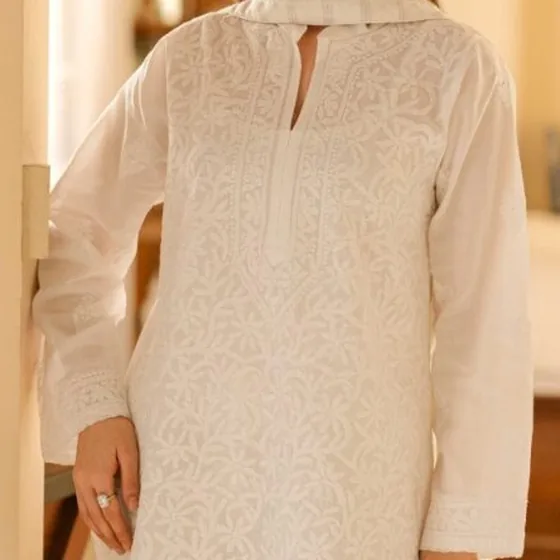
Chikankari
Shadow work stitched by hand, one panel at a time.
Chikankari is worked with a needle and untwisted thread, the pattern built from a small vocabulary of stitches rather than printed or machined on. Because it is done by hand, the density varies slightly across a piece and no two garments are identical — that irregularity is the mark of the real thing, not a flaw. It also behaves differently over time: the thread softens and the ground cloth opens up with washing, so a chikankari kurta tends to get better for the first year rather than worse.
- Worked on
- Mulmul and fine cotton
- Feel
- Light, breathable, softens with age
- Best for
- Heat, long days, everyday and occasion alike
- Care
- Cool hand wash, no bleach, dry in shade, press on the reverse
Everyday
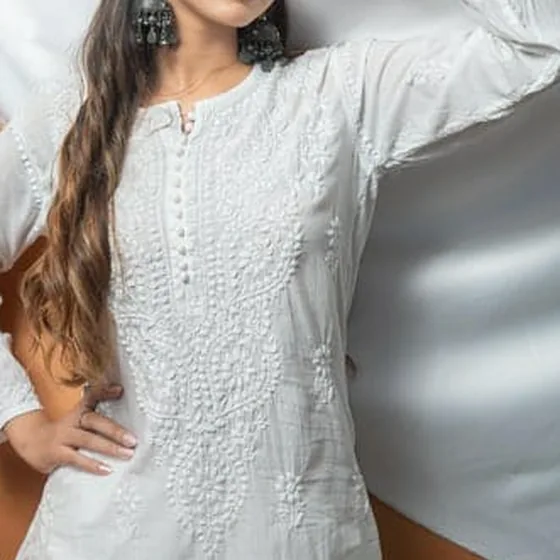
Mulmul cotton
The lightest cotton we work with, and the reason our everyday pieces hang the way they do.
Mulmul is a loosely woven, very fine cotton — light enough to move with you and open enough to breathe in real heat. It takes embroidery well without the ground buckling, which is why it carries chikankari so often. It creases easily; that is the trade for the weight, and a press while slightly damp settles it in seconds.
- Weave
- Fine, loose, breathable
- Feel
- Barely-there, drapes close
- Best for
- Summer, travel, all-day wear
- Care
- Cool hand wash, dry in shade, press while slightly damp
Block print
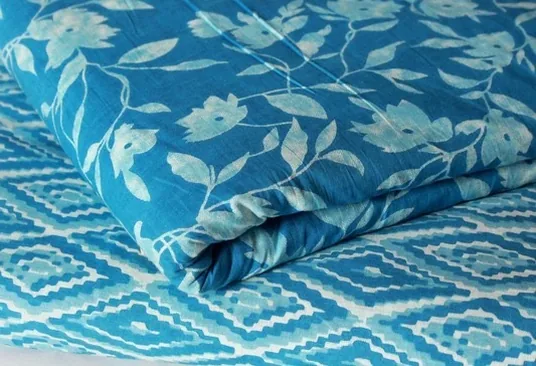
Ajrak-inspired motifs in indigo and teal, printed onto cotton and finished properly at the edges.
Block-printed cotton carries pattern the way a weave cannot — the motifs repeat but never land identically, and the dye sits in the cloth rather than on it. We use two scales together: an open floral jaal for the body and a tighter geometric for borders and trousers. The pieces are finished with a scalloped, embroidered edge at the hem, cuffs and side slits instead of a plain turn-up, which is what keeps a printed cotton from reading as casual.
- Base cloth
- Cotton
- Finish
- Scalloped embroidered hem, cuffs and slits
- Best for
- Everyday, layering, travel
- Care
- Wash separately the first two times — dyes can bleed
Hand work
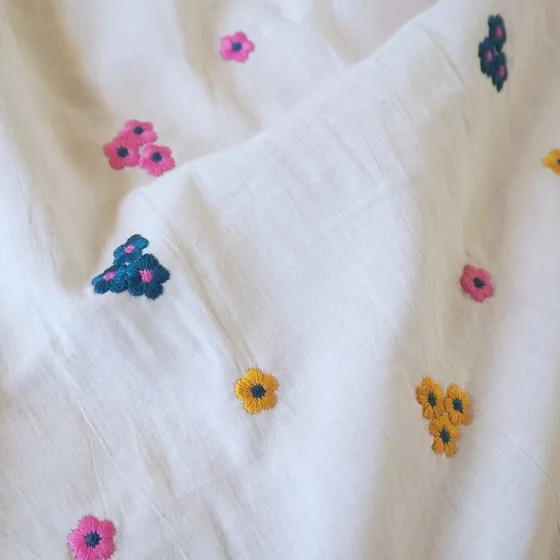
Thread embroidery
Small coloured motifs scattered across a plain ground — the quietest way to wear embroidery.
Where chikankari is tonal and all-over, thread embroidery is placed: individual flowers in pink, navy and mustard worked a few inches apart across an ivory cotton, so the cloth still reads as plain from across a room and only resolves close up. Each motif is a handful of satin stitches around a French-knot centre. It suits people who want colour without pattern, and it sits well under a plain dupatta.
- Worked on
- Cotton and lawn
- Feel
- Plain cloth, raised motifs
- Best for
- Everyday, work, quiet occasion
- Care
- Cool hand wash, press on the reverse so the motifs stay raised
Dupattas
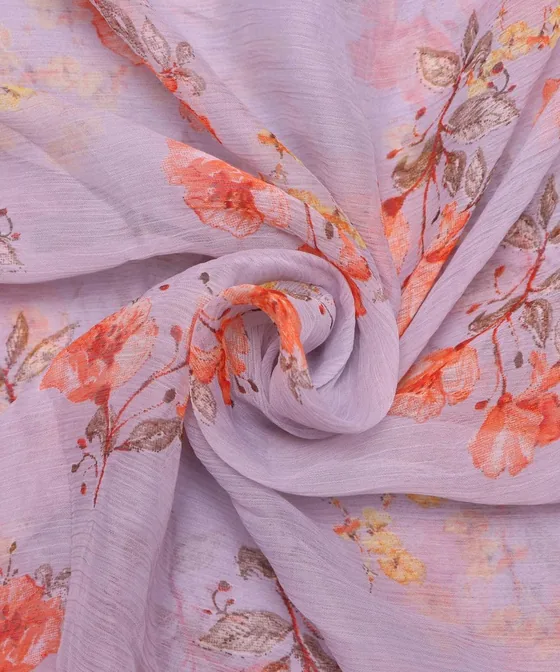
Printed chiffon
Weightless, slightly crinkled, and the piece that carries the colour in an outfit.
Most of our three-pieces put the pattern in the dupatta and leave the kurta plain — it is more wearable, and it is far kinder at larger sizes than pattern across the body. Printed chiffon is what makes that work: light enough to fall in soft folds rather than sit on the shoulder, with a slight crinkle that keeps the print from looking flat. It is also the one fabric we will not let near a washing machine.
- Weave
- Crinkle chiffon
- Feel
- Weightless, fluid, slightly textured
- Best for
- Dupattas, occasion, layering over plain kurtas
- Care
- Dry clean. Press on low, on the reverse, under a cloth
Occasion
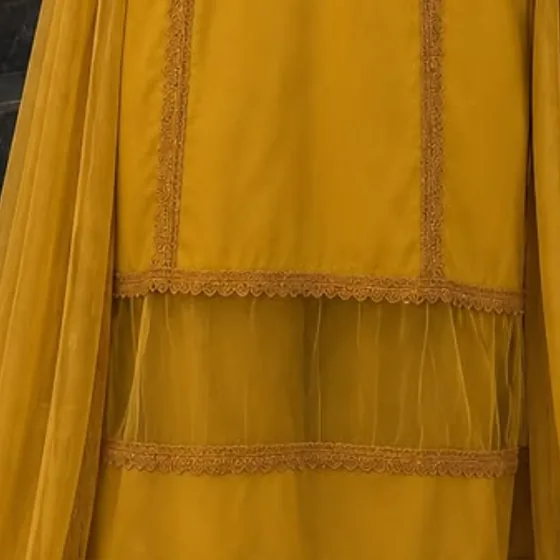
Lace & organza
Tonal lace set into the panels, a sheer tier at the hem — weight where it drapes, air where it doesn't.
On the occasion pieces the lace is structural rather than decorative: set into the placket and the length of the side panels so it shapes the silhouette, in a thread matched to the cloth so it reads as texture rather than contrast. A sheer organza tier at the hem keeps the drop long without adding bulk through the body — which matters far more at XL and above than it does at a small.
- Ground
- Cotton silk and cotton lawn
- Lace
- Tonal cotton lace, set into panels
- Best for
- Eid, weddings, evening
- Care
- Dry clean the chiffon and organza; press on the reverse
Keeping it well
Care at a glance
Hand embroidery and fine cotton reward a little care. None of this takes long.
| Fabric | Wash | Dry | Press |
|---|---|---|---|
| Chikankari | Cool hand wash, mild detergent | Shade, no wringing | Reverse, cloth over the work |
| Mulmul cotton | Cool hand wash | Shade | While slightly damp |
| Block print | Separately for the first two washes | Shade, inside out | Medium, reverse |
| Thread embroidery | Cool hand wash | Shade, flat | Reverse, so motifs stay raised |
| Cotton lawn | Cool hand or gentle machine | Shade | Medium |
| Chiffon & organza | Dry clean | — | Low, reverse, cloth over |
| Cotton silk | Dry clean | — | Low, reverse |
No bleach on anything. Store embroidered pieces folded rather than hung, so the weight of the work doesn't pull the shoulders.
Not sure which fabric suits you?
Tell us where you'll wear it and how hot it gets. We'll point you at the right cloth.